We need to talk about Ms. Cobel
As we noted in analysis of S1E1, she typically storms the screen with an icy blue, a temper (the significance of this word we shall unpack shortly) that seeks to quell the fiery red that flickers in and out of the consciousness of workers on the severed floor. The ominous ending to that first episode intimated that, while her wintery business has its office underground, it also warrants her prying into Mark's outie's personal life in Baird Creek's subsidized Lumon housing. Indeed, it seems that Miss Cobel lives in Mark's housing complex, too. From the state of her fridge, though, which we see in the foreground of a shot that implies surreptitious surveillance at work in her intimate space– a sense that has already been produced in Mark's home with objects littered in the frame's foreground– it doesn't appear that she spends very much time making a home there. (Not too unlike Mark, perhaps.)
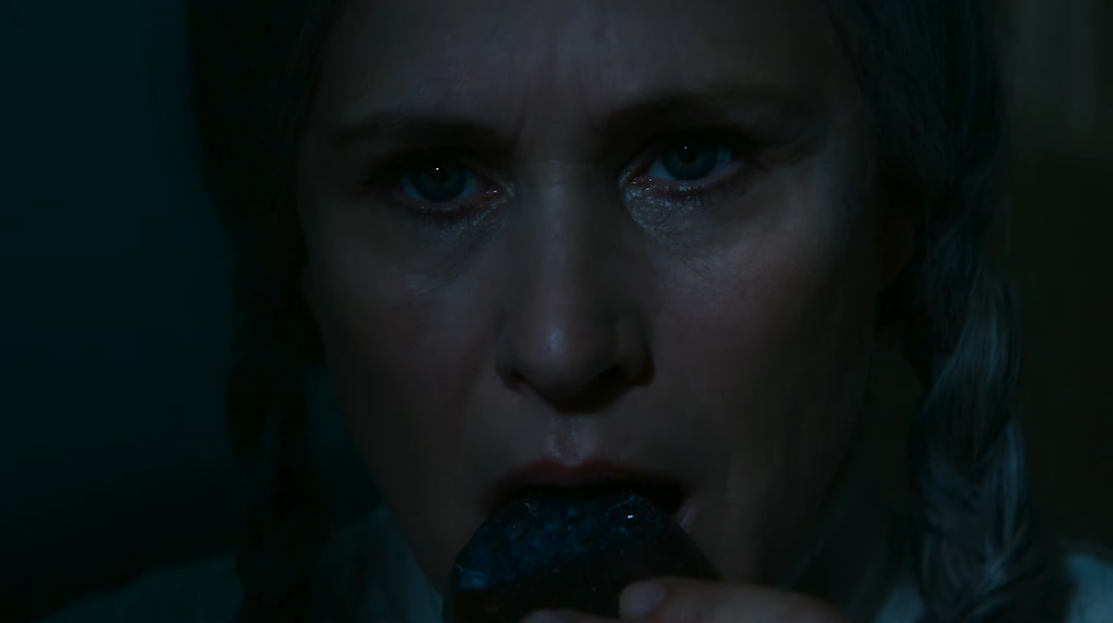
Ms. Cobel is a kaleidoscopic vector of strange femininity in the show. She is at once old widow next door, a girl-boss superior on the severed floor, and a little girl prone to tantrums. As Mrs. Selvig, the hare-brained widow next door, she offers Mark unwanted company and cruddy cookies. Yet we know by now that this is apparanetly a ruse, a senile disguise through which the conniving Harmony Cobel can keep an eye on her employee, Mark, beyond the bounds of his time at work. At Baird Creek, she is a middle-aged executive in the clothing of an older and less cognitively composed character.
But even if Ms. Cobel is the 'real' Mrs. Selvig, there is still something anile about her character. She can be both comandeering and childish, as we see in her encounter with (innie) Mark S when he arrives unannounced at her office to request a kind of permission to take Hellie to the perpetuity wing in S1E3. Commandering, because she accosts Mark with bureaucratic demands in her role as his boss ("And have you filled out a common-reservation slip?"). Childish, because she literally throws a mug at him out of a petty frustration that is unbefitting of a mature manager. Cobel rationalizes her childish temper as follows:
What I just did was something I knew that you could handle and grow from. It was very painful for me. I hope that you'll let it help you.
This outburst locates something undecided within Ms. Cobel, a moment in relation to Mark where she lets her personal anger supersede her role as his manager. This mug-throwing episode demonstrates that Cobel, too, is capable of breaking character as head of the severed floor and allowing some other aspect of her self to seep in, despite the pretense of a calm composure. The thrown-mug, in other words, is the wish fulfillment heralded by Cobel's stunningly funny, inappropriate remark to Hellie during her orientation in S1E1; "I’ve wanted to pummel Mark myself, but I am his employer." Even Cobel, who is supposed to be more in charge of herself than the MDR employees who are her inferiors– her breaking into Mark's house while he isn't there implies is that she is unsevered, and thus more 'responsible'– harbors desires that exceed and contradict the prescribed role she is supposed to play.
The image of Cobel above confirms her as childish in some respects. Notice that here, at 'home', she wears her hair in pigtails rather than loosely around her shoulders. But it also paints her as a scopophilic and overbearing mother. Whatever she is doing creating excuses to talk to Mark's outie as Mrs. Selvig, it becomes clear in this episode that there is a convoluted kind of care at stake in her creepy and overcurious work. Peering at him as he wanders up from the basement (Cobel doesn't seem to know that Petey is also down there at this point, though her break-in later in the episode suggests that she suspects something is awry), she murmurs to herself, "Oh, Mark. Are you all right?"
This is a strange exhibition of affection, coming from the same woman who will throw a mug at Markfor his failure to "get MDR to its numbers" as department chief, who knowingly subjects him to the break room– which we observe on screen for the first time later in the episode– and who steals the book left by his brother-in-law as a gift at his doorstep. Despite these mistreatments, Cobel does still seem to hold some perverted penchant for and attachment to Mark. As HaxDogma notes in his review of this episode, it is hard to see Mark's promotion to department chief after Petey disappears as anything other than a nepotistic appointment, given that Irving is clearly the more experienced refiner in a number of respects (orientation procedure, group photo protocol, number of years spent on the severed floor, to name a few). Cobel's overinquisitive manner on display in this episode is perhap best described as motherly, even as she is certainly not a paradigmatically good mother.
There is also something undoubtedly sexual about Cobel's relationship to Mark. Her lingering at the door in S1E2 waiting to be invited in, her awkward and suggestive mention of her late husband's building an apartment in the back of their abode in heaven "in case I found a new man before I got there", her creating an excuse to talk to him by pretending to de-ice her stoop; and, naturally, her peeping at him through the window. She is either a stalker by-the-book, or (more charitably) a lonely woman who is searching for some missing satisfaction. Most likely, she is an inextricable concoction of the two. Cobel wants to have Mark's cake and eat it too; to be at once his mother, his corporate superior, and (we can't help but suspect) his lover. Like many put in positions of power, she has trouble setting her more inapproriate desires aside so as to simply 'do her job'.
Primal father figures
Cobel's mother energy is arguably muted and mixed up in her Sphinxesque triplicity. But the father energy on display in this episode is, by contrast, loudly and proudly pronounced in at least three different figures: Petey, Irving, and, of course, Kier Eagan.1 Before tackling these fathers one by one, it is instructive to straightforwardly and schematically lay out the Oedipus complex, an 'absolute fiction' that nonetheless, Freud claims, depicts something foundational about the graph of the speaking subject (the graph in which we took interest in our analysis of S1E1).
The Oedipus complex is so-named because it takes its architecture from the figure of Oedipus as he appears in the ancient Greek playwright Sophocles' trilogy, which consists of the plays Oedipus Rex, Oedipus at Colonus, and Antigone. (Oedipus' tragic tale is drawn from a mythology that predates these plays, but the story is nonetheless usually traced to its Sophoclean production.) Oedipus is well-known to students of psychoanalysis because of Freud's making him into a complex, which is generally (mis)understood as 'every person wants to kill their father and fuck their mother'. (Famously, Oedipus killed his father– at a crossroads, thinking he was simply a threatening stranger at the time– and married his mother– not understanding that relation in the moment of the act, either.)
Jacques Lacan rendered the Oedipus complex more philosophically significant than this overblown and crude Freudian telling. For Lacan, the Oedipus complex designates an abstract account of how desire is produced by the speaking subject in relation to the formative figures with which it is in relation. As he notes in one of his 1938 text, The Family Complexes:
our criticism since Freud presents this psychological entity [the Oedipus complex] as the specific form of the human family and subordinates all social variations of the family to it. (Lacan 2002, 35)
The Oedipus complex is not so much a diagnosis of a particular perversion that is presumed universal, in the sense that everyone consciously suffers by repressing these secret dual desires to kill (my father) and to fuck (my mother). It is rather an important part of how he architects a philosophy of the subject's relation to itself (and others) by way of a "triangular conflict" (Lacan 2002, 41) between three figures: one's self, the Mother, and the Father.
The Mother is the subject's first known object that is seen as separable from one's sense of self. We can imagine this through the process of weaning, of a mother teaching her baby that sustenance ought to be sought in solid foods rather than directly from her teat. Originally, a baby does not have a firm enough sense of itself to recognize that the Mother's teat is separated from its own body. When it wants nourishment, it cries, and a breast brimming with milk appears (assuming a good mother, here). The breast seems almost part and parcel of the baby, from its perspective, as what reason does it have to think otherwise? (We are assuming here that the separation between a baby's sense of its own body and the world is not ingrained at birth, but rather learned, acculturated.) It is only when the baby's crying stops precipitating a breast that it should start to doubt this part of itself, to think that perhaps my Mother's breast is not part of me as subject but rather its own kind of thing, a separate object. Thus the Mother is, in this developmental sense, the subject's first 'proper' object. The Mother (and her breast), the baby subject thinks, is both mine and not mine, as though there is some relation that my Mother has to me, she is not (quite) the same as me.
The Father, on the other hand, incorporates (into) the baby subject's sense of self differently. It is not considered, as the Mother is, a part of the subject that was at some point taken away, but rather represents the source of that action of taking away. If the Mother ought (in the terms of the baby subject's nascent ethics) to be a part of me, the Father is the force and figure responsible for taking her away. This stature of the Father is better understood, perhaps, with reference to the myth of the Primal Father, which Lacan reinterprets from its presentation in Freud as originally depicted in the fourth and final chapter of Totem and Taboo (Freud 1919). Like the Oedipus complex, the myth of the Primal Father is a narrativization that helps to understand the structure of the subject. Suppose a primal horde, Freud offers, at the helm of which exists a Primal Father who monopolizes all women. All women in the horde, in other words, are sexually subject to this single male; no other male gets to enjoy anything of them. A band of brothers, resentful of the Father's monopoly on enjoyment, conspire to escape the ban on sexual enjoyment through a plot to murder him.2 They do so through what could be called an original jealousy, a feeling that the Father is enjoying in a way that is prohibited (by virtue of the Father's taboo) for each of them.
Freud offers this as an "historic explanation… [of] the origin of incest" (Freud 1919, 207), as the Primal Father's taboo on enjoyment is what, Freud suggests, drives exogamy, wherein each of the band of brothers leaves that original tribe to start their own in which they can (finally) enjoy the women for themselves. That this is an historic explanation does not mean that Freud believes that it represents an actual state of affairs in some distant past. Indeed, he states the opposite, that "primal state of society has nowhere been observed." (Freud 1919, 233) The parable of the Primal Father is historic rather in the sense that narrates to us an important aspect of the structure of the subject, much like Oedipus' tragedy.
Daddy issues at work
Okay: we now return from this Freudian digression to the stuff of Severance. What bearing do the Oedipus complex and the myth of the Primal Father have on the structure of the subject on display in the show? Let's go now to the scene in S1E3 at the crossroads, where MDR runs into two employees in Optics and Design (O&D).
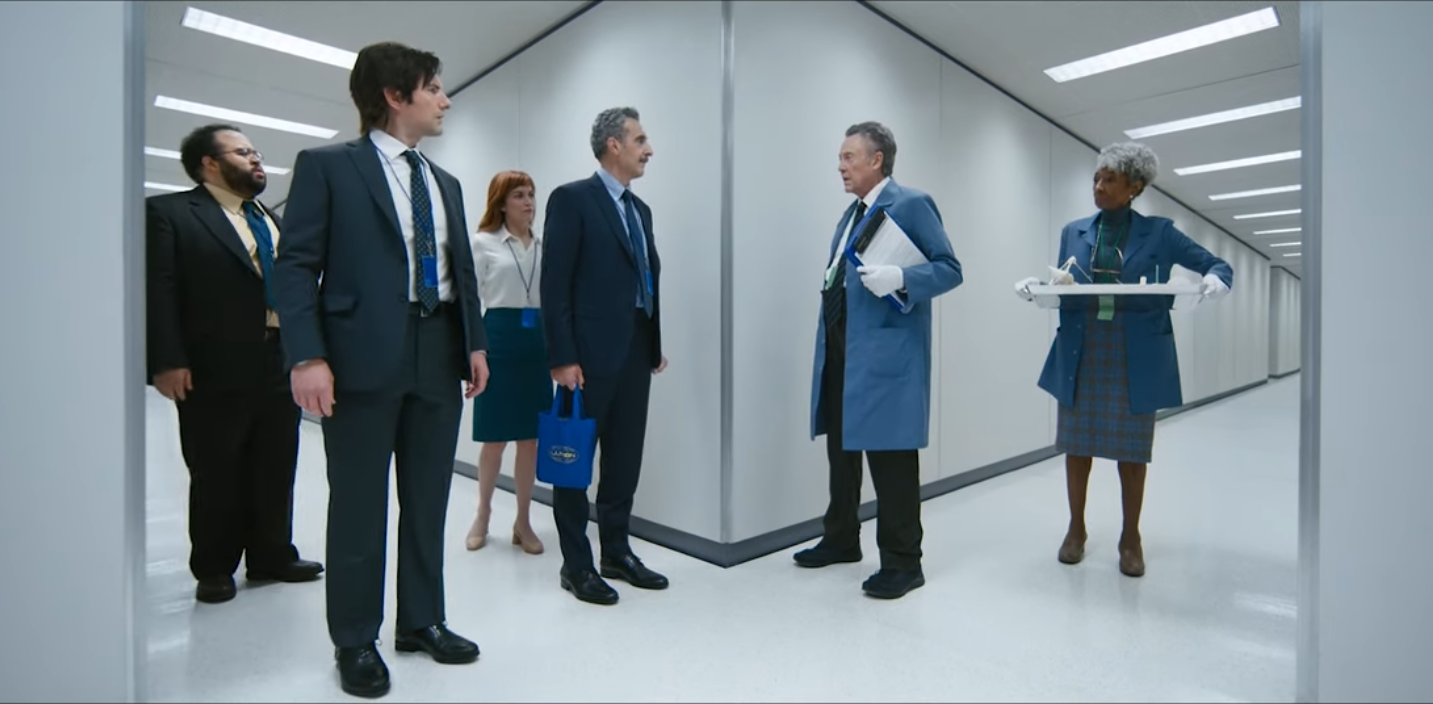
The composition of this shot puts the reflective axis down the center, and the encounter is suggestively Oedipean in its structure (at a crossroads, unknowing of the Other at play). Note that Irving is compositionally mirrored by Burt, played by Christopher Walken, and we will explore this suggestive symmetry in detail in later episodes. The two departments (MDR and O&D) know of each other, we surmise from the dialogue that follows. But Irving isn't supposed to know Burt by name, as he accidentally happened upon him in S1E2 on the way to a Wellness session. (Burt was coming from his Wellness session.)
While Irving greets Burt on the back of this previous encounter with gentle and flirtatious warmth, Dylan's hostility towards O&D is clear. In place of the camaraderie that one might have hoped for between the two factions given their shared plight as severed workers, there appears to be an enmity built on a mythology (what Irving calls an "absolute fiction") of otherness:
Kier sorted the departments by virtue. Macrodats are clever and true, while O&D’s more cruelty-centered…. O&D tried a violent coup on the others decades ago, and that’s why they reduced them down to two. And that’s why they keep us all so far apart now.
Kier is evidently the Primal Father of the severed floor, responsible for instituting the symbolic system of rules, regulations, and affects in the various 'bands of brothers' which reside there. The tour of the perfect replica of Kier's house later in the episode reinforces his architectural status as Primal Father. Irving chides Mark for his lack of reverence in deigning to turn the tour of the Perpetuity Wing into Eagan Bingo, and is aghast when he almost happens to "bed sit" on the facsimile in his duplicate chambers. (Thou shall not lie in Kier Eagan's bed.) Kier and the lineage of Eagans more generally constitute the law of the father, the signifier of authority that keeps the severed floor's social order intact, the symbolic source from which both rules and the forbidden temptations of their being broken, taboos, sprout. Irving fosters this authority during the tour, standing in for the absent caregivers, existential (Kier, the Eagans) and material (Cobel and Milchick as superintendents who seem to be letting the kids take care of themselves for a short period).
Another paternal authority whose absence has haunted and structured Mark since the show's opening is Petey, the man whose shoes he stepped into as MDR's department chief. As per his exchange to Cobel in the mug-throwing scene, Mark lionizes Petey as a tone-setter, often acting through an ethics refracted by the subordinate conjunctive, 'if Petey were here', or the preface 'Petey used to say'. Mark's innie is steered more by an imagined sense of what Petey would do, rather than what Kier would.
Thus while it is Cobel who is explicitly in charge, the spectral presence of these father figures– Kier, Petey, Irving– correlatively structures the subject on the severed floor. There is, in other words, an Oedipal triangular conflict at work in relation the ethical imperative of a severed worker. The four members of MDR, as orientations to the structure of this subject, suffer different relationships to the positions of Mother and Father. Mark S is a momma's boy, sired more by Petey's radical rejection of company policy than by Kier. Dylan, though impertinent to the minutiae in the structure of Law at times, is ultimately his Father's son, acquiring satisfaction by accumulating accolades, and apparently driven by the impending idea of another finger trap or a waffle party. Irving seems at this point the most mature of the children, looking reverentailly to Kier. Yet recall that he has been chided by Milchick already for falling asleep on the job, so not all is perfect in paradise. Hellie has no time for Cobel's authority, yet we will see in due course that her relationship with a Father is a deep lineament in her personality, too.
Taming tempers
The count of four in the members of MDR mirrors the exact amount of tempers that we learn about from Kier Eagan's wax simulacrum speaking during the tour of the Perpetuity Wing. These tempers are crucial as coordinates of the Eaganic attempt to coherently quantify the subject, and Kier's pronouncement is deeply significant for our investigation of the subject's distorted structure on the severed floor:
I know that death is near upon me, because people have begun to ask what I see as my life’s great achievement. They wish to know how they should remember me as I rot. In my life, I have identified four components, which I call tempers, from which are derived every human soul. Woe. Frolic. Dread. Malice. Each man’s character is defined by the precise ratio that resides in him. I walked into the cave of my own mind, and there I tamed them. Should you tame the tempers as I did mine, then the world shall become but your appendage. It is this great and consecrated power that I hope to pass on to all of you, my children.
If there was any doubt that Kier Eagan embodies the Freudian Primal Father, the foundational component of absolute fiction on which the edifice of Law (the rules and taboos by which a subject is bound to abide) is constructed, the quotation above should put it to bed. Kier's 'philosophy' seeks to conquer death by quantifying life, sorting its myriadic nature into a "precise ratio" of character that can be counted (completely, it seems) in four distinct tempers. Indeed, we saw the pictorial representation of this taming in s1e2, in the scene where Irving meets Burt:

In the post-Platonic cave of his own mind, Kier is the master of his passions. He admits no unconscious contours that sneak up on him unbeknowst in Freudian slips of the tongue or unwanted symptoms. Indeed, the Eaganesque fantasy of the subject is one in which the necessary excess of language that psychoanalysis discovered does not exist. Words are detected (via sensors in the elevator, say), controlled, managed. Any psychoanalytic excess is, in Kier's project of a precisely rationalized subject, beaten out of language. Excess meaning is 'tamed' as if it were a wild animal by a clear-headed, upstanding, divinely radiant visonary. (As we will see, the position of primal power that Kier occupies here is sexually overbearing, too, as we might suspect from the Freudian analogy.)
This episode ends with two scenes depicting the dark and bloody underside of Kier's waxen vision of the precisely quantified human subject. The first is Helly's harrowing experience in the break room, a space where the unruly distance between words as they are uttered and the meaning they convey is thought to be stamped out, suffocated by the drudgery of debilitating repetition. A subject will not exceed its authorized symbolization, the break room seems to want to claim. The worker's unconscious will be tamed and ultimately made beholden to a regime of conscious rationality. The second, and the closing scene of the epsiode, is Petey's psychotic demise at the convenience store, where he yells at wit's end: "I need tokens so I can eat!" Ravaged by the failure of his complete quantification inside Lumon, Petey seems no longer to have a firm footing in either his innie's or outie's reality. Mark looks on from a distance as he collapses outside the store, escorted by police, attempting (it seems) to account for his disintegration.
Bibliography
There is foreshadowing, too, of a fourth father figure in Rickon, Mark's brother-in-law. While reading his confiscated book, Milchick quietly remarks to himself a thought that will become an important refrain for many other characters with respect to Rickon later in the season: "This is… Jesus."↩︎
There has been much written on Freud's mythos of the Primal Father. For a relatively recent use of the concept that serves as a reasonable introduction to Lacan's reading of Totem and Taboo, see (McGowan 2021).↩︎